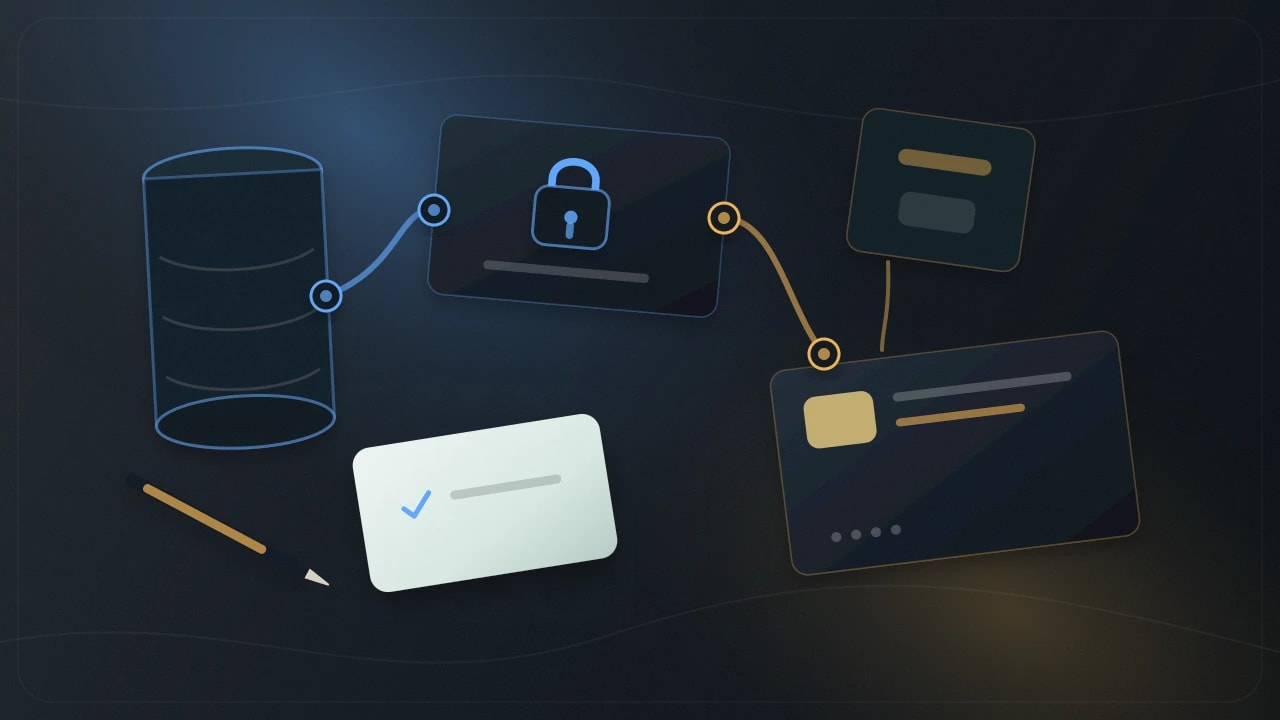
Most vibe-coded apps become real the moment they need to remember data, know who the user is, and charge money. Databases, auth, and payments are the layers where casual prompting must give way to careful review.
Database: what the product remembers
A database stores the state of the product: users, projects, runs, files, invoices, settings, and history. Before an agent creates tables, write the nouns and relationships in plain English.
Good database prompting says what should be stored, who owns it, how it is displayed, and what can be deleted. Bad prompting says 'add a database' and lets the agent guess.
Auth: who is allowed to see and change things
Authentication confirms identity. Authorization decides access. Vibe-coded apps often add login UI while forgetting server-side checks. Every private API route should verify the user and check ownership before returning data.
If your product has teams or roles, slow down. Permissions are product logic, not decoration.
Payments: money plus state
A payment integration is not complete when checkout opens. The app must know the subscription state, handle webhook events, block unpaid access, support cancellation, and explain failures.
Payment code should use official patterns and environment variables. Never ask an agent to hardcode a secret key or trust a price sent from the browser.
The safe build order
For many MVPs, start with local or mock data, then add persistence, then auth, then payment. This lets you prove the core workflow before sensitive layers enter the system.
When you add a sensitive layer, run a dedicated review and document what was verified.
What to test before launch
Test a new user, returning user, logged-out user, unpaid user, canceled user, failed payment, empty data state, and permission boundary. Those cases catch more real launch issues than another homepage polish pass.
Next on Boostor
Use Business Builder to turn the idea into a first offer, Rank My Stack to pressure-test the stack, Command Center to keep the launch board visible, and Pro when you want the full builder loop.
Sources and further reading
- U.S. Small Business Administration: 10 steps to start your business
- Google Search Central: AI-generated content guidance
- OpenAI Codex: Agent Skills
FAQ
Can an AI agent add auth and payments for me? It can wire the code, but you should review the implementation carefully and follow official provider documentation for security-sensitive flows.
What is the difference between auth and authorization? Auth proves who the user is. Authorization proves what that user is allowed to access or change.
Should I add a database before validation? Not always. If a manual or static prototype can validate demand, start there. Add persistence when saved state is required for the user to get value.